- Opinion | China’s AI Moment Will Be Decided in the Classroom, Not Just the Cleanroom
- OPINION
- 2026-01-13 17:33
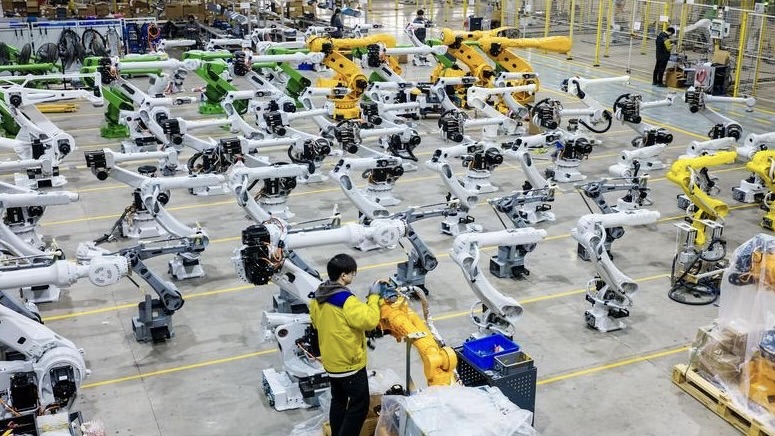
China’s recent AI discourse, as reported by Reuters, reflects a quiet but growing confidence that deserves serious attention. Rather than claiming imminent technological dominance, leading Chinese researchers are articulating something more credible: China is steadily narrowing the gap with the United States by innovating under constraint, cultivating talent, and rethinking how the entire AI system, from chips to algorithms to people, fits together.
Much of the public conversation about AI leadership still revolves around hardware. On that front, China’s challenges are real. Limited access to the most advanced lithography machines continues to constrain domestic chip production, while U.S. firms retain a significant advantage in computing scale and capital investment. Even optimistic assessments suggest that China’s most advanced homegrown semiconductor tools may take several more years to reach full maturity. Yet focusing solely on this hardware gap risks missing a more important transformation already underway.
Chinese researchers increasingly frame constraints not as fatal weaknesses, but as catalysts for creativity. Scarcity of computing resources has accelerated innovation in algorithm: hardware co-design, enabling sophisticated AI models to run efficiently on smaller and more affordable systems. This emphasis on efficiency, integration, and optimization reflects a deeper national strength: systematic thinking. Rather than treating AI as a series of isolated technical breakthroughs, researchers of China increasingly approach it as a coordinated ecosystem involving infrastructure, energy, software, governance, and long-term planning.
This systemic mindset becomes especially important when AI moves from the laboratory into everyday life. Consider elderly care, a growing social challenge in China and many aging societies. AI systems designed to support older adults are not primarily about raw computing power. They are about communication: listening patiently, responding empathetically, understanding dialects, cultural references, and emotional cues, and maintaining meaningful interaction over time. An AI companion that reminds an elderly person to take medication but cannot hold a warm, context-aware conversation will do little to improve well-being. By contrast, an AI system that can converse naturally, tell familiar stories, recognize loneliness, and adapt its language to individual preferences can meaningfully enhance happiness, dignity, and social connection.
Such applications highlight why education is decisive. To translate technical momentum into lasting leadership, China’s foundation must lie in STEAM education—science, technology, engineering, arts, and mathematics—taught as an integrated way of thinking rather than as separate silos. Building AI for human-centered domains like elderly care requires more than programming skills. It demands mathematical abstraction and engineering discipline, but also linguistic sensitivity, ethical reasoning, and design thinking. The “A” in STEAM is not decorative; it is essential for creating AI systems that interact naturally with people.
Language education is central to this vision. English fluency remains vital for participating in global research, engaging with open-source communities, and contributing to frontier AI development. At the same time, China’s deep linguistic and cultural understanding of Chinese, across regions, dialects and generations, offers a unique advantage in building language models that can serve real social needs. An AI companion for elderly users must speak not only grammatically correct Chinese, but the language of memory, tradition, and trust. Combining global scientific communication with deep native-language mastery positions Chinese AI applications to be both internationally competitive and socially meaningful.
Another encouraging development is the evolving entrepreneurial culture. As industry leaders note, younger Chinese AI founders are increasingly willing to embrace risk, a trait long associated with Silicon Valley. This shift matters. Breakthroughs in applied AI, especially in socially sensitive domains such as healthcare and aging, require experimentation, tolerance for failure, and long development cycles. When risk-taking is paired with strong educational foundations and institutional support, it can yield durable innovation rather than short-lived speculation.
Ultimately, the AI competition between China and the United States should not be understood as a simple race for more chips or larger data centers. It is a contest of systems: educational systems, research ecosystems, and innovation cultures. China’s ability to mobilize talent, innovate under constraint, and think holistically across the AI stack suggests that its progress is neither accidental nor temporary.
The next global AI leader may well emerge not from the country with the fewest constraints, but from the one that turns constraints into discipline and education into a strategic advantage.
References
Reuters. (2026, January 10). China is closing in on U.S. technology lead despite constraints, AI researchers say. Reuters. https://www.reuters.com/world/china/china-is-closing-us-technology-lead-despite-constraints-ai-researchers-say-2026-01-10/
By Miss Tiffany Wong
Student at Monash School of Medicine, Monash University
Dr. Philip Wong
Deputy Director of STEAM Education and Research Centre, Lingnan University
Mr. Xiongyi Guo
Assistant Research Officer of Pan Sutong Shanghai-Hong Kong Economic Policy Research Institute, Lingnan University
The views do not necessarily reflect those of Orange News.
Cover Photo: Xinhua
責編 | 李永康
編輯 | 芊芊
編輯推薦
-
![]()
Opinion | A New Rhythm for LegCo and the Administration
Opinion | 2026-08-03 17:13 -
![]()
Opinion | Professional Ethics at the Heart of Medicine: Admission Standards and Moral Responsibility
Opinion | 2026-07-28 16:47 -
![]()
Opinion | Hong Kong’s Book Fair: Reading Still Matters
Opinion | 2026-07-28 16:47 -
![]()
Opinion | HK Is Not Over, but in the Process of Transformation
Opinion | 2026-07-28 16:47 -
![]()
Opinion | As Trust Improves, Cooperation Becomes Easier
Opinion | 2026-07-23 09:48 -
![]()
Opinion | Private Capital Helps Turn Climate Resilience Into Reality
Opinion | 2026-07-20 10:49







香港五年規劃·懶人包6|聚焦區域合作 鞏固對外開放橋樑角色

東壩破邊洲路段下月試行實施預約制度 首批名額今起開放預約

天文台:太平洋及南海現「四旋共舞」 開學日天氣仍存變數
有片|衞生署下月推「學前兒童口腔健康外展計劃」 至今逾70%幼稚園參與