- How does the art form of an “arranged marriage” finds its meaning in Hong Kong
- HK Eye
- 2025-06-17 16:33
Internationally renowned artist Xu Bing has served as Hong Kong’s Ambassador for Cultural Promotion since 2024, with “Xu Bing in Hong Kong: Square Word Calligraphy” as his first commissioned art project. “Mixing Chinese and English, two completely different writing systems, is like an arranged marriage — it’s incompatible, but you make it work.” This is Xu’s interpretation of Square Word Calligraphy.
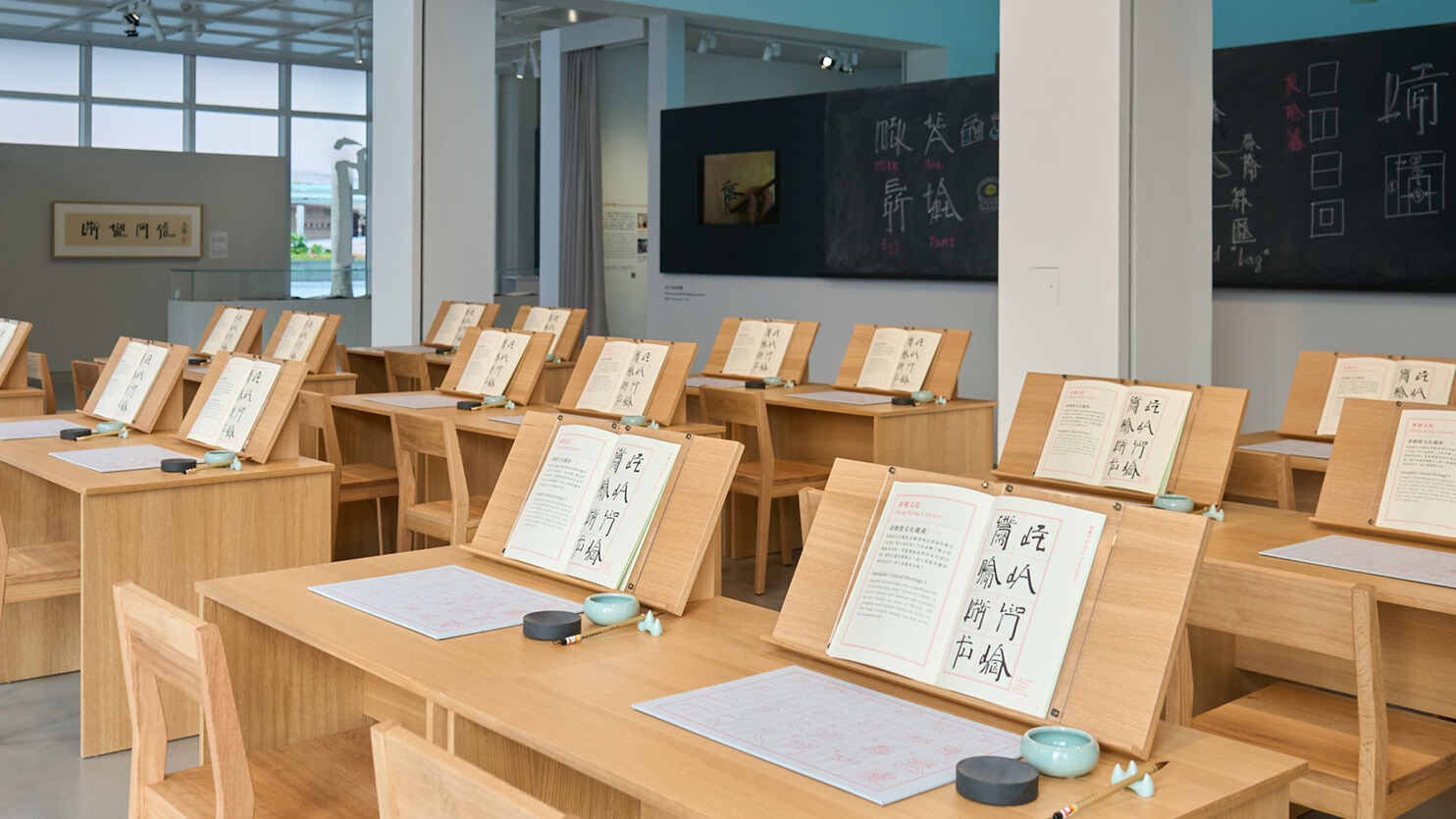
The project features a series of programs, including the exhibition “Eying East, Wondering West – Square Word Calligraphy Classroom” at the Hong Kong Museum of Art from March 26 to July 30, 2025, which transforms the exhibition space into a classroom. It also includes new calligraphy works, displayed in four MTR stations from March to September 2025, that infuse everyday life with a touch of culture.
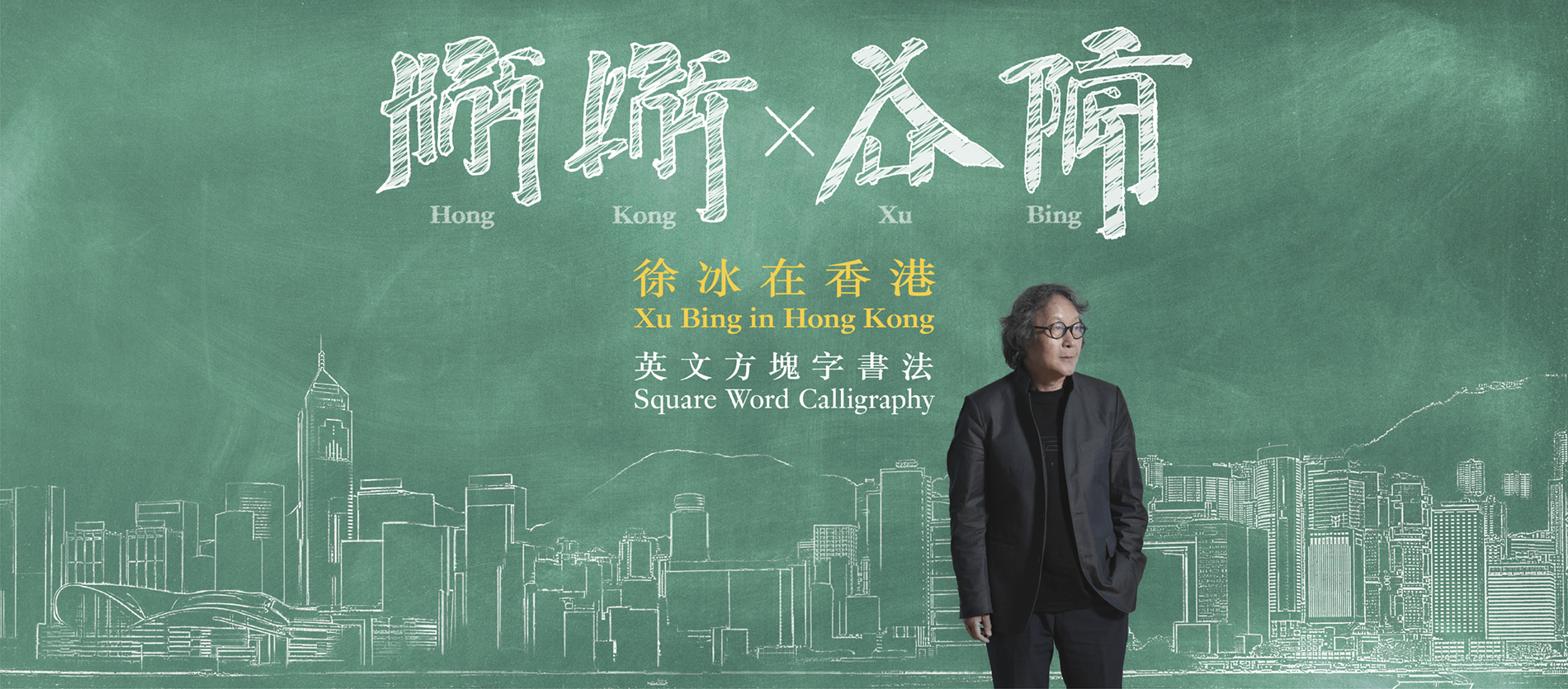
Exhibition poster (Photo: Art Promotion Office)
Square Word Calligraphy is a unique writing system that Xu Bing began developing in 1993 by merging Chinese calligraphy techniques with the English alphabet. Unlike the “false characters” in his earlier work “Book from the Sky,” Square Word Calligraphy consists of real, readable words. The system can be deciphered by combining English letters following the structural rules of Chinese characters — left to right, top to bottom and outside to inside.
The inspiration for this work came from the language and communication challenges Xu faced while living in the United States. “Problems create art. Living in New York — a space between different cultures — led me to create work like this,” Xu once wrote in an essay titled “Square Word Calligraphy.” “Trying to create art with the English language helped me understand the nature of different linguistic systems. Understanding the core of various languages helped me grasp cultural differences, and those differences inspired my urge to ‘graft’ them together.”
To further connect Square Word Calligraphy with the Hong Kong context, the exhibition includes phrases that reflect the city’s unique linguistic or cultural character, such as “long time no see,” “egg tart” and “yum cha (drink tea).”
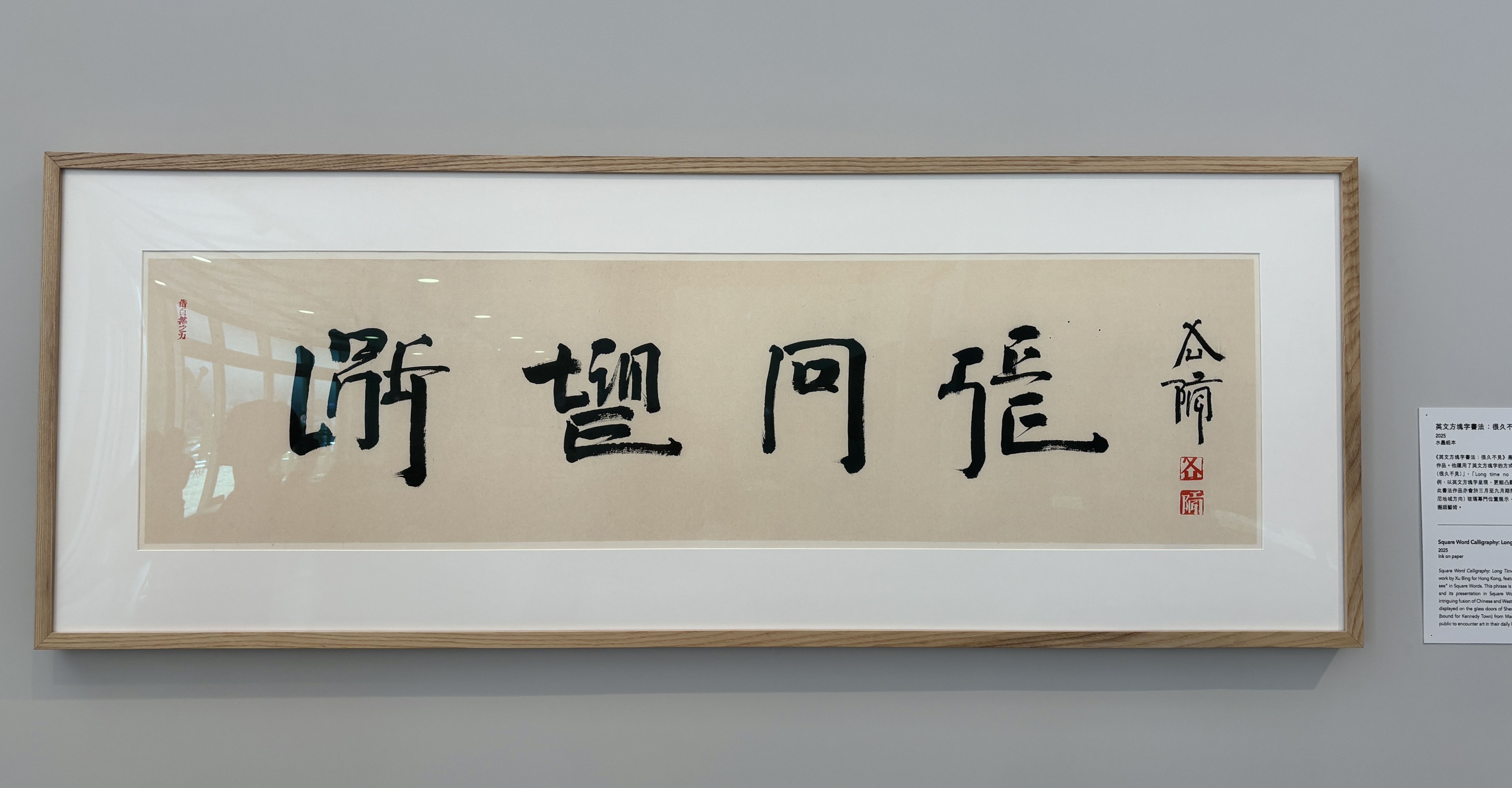
“Long Time No See” in Square Word Calligraphy (Photo: Orange News)
“Hong Kong blends Western modernity with strong Chinese traditions and regional culture. It’s truly a multicultural intersection,” Xu says. “That’s why showing Square Word Calligraphy here and sharing it with Hong Kong people feels so fitting — this writing style strongly resembles how Hong Kong expresses its culture.”
The exhibition invites visitors to explore Square Word Calligraphy from the perspectives of “appreciation”, “learning” and “application.” In the “learning” section, the gallery is transformed into a classroom where visitors can trace characters using brushes and calligraphy guides, creating an interactive experience.
“The gap between contemporary art and everyday people seems to be widening. A calligraphy classroom creates a sense of familiarity,” Xu explains. In his book “The Real Character of Mine,” he also noted that classrooms evoke memories and aspirations of learning, and incorporating this setting helps counter the dryness often associated with contemporary art.
Outside the “classroom,” some of Xu’s works are featured in the “Loping and Looking — Art in MTR” program at four MTR stations from March to September 2025, marking the first time his work has appeared in a public transportation space.
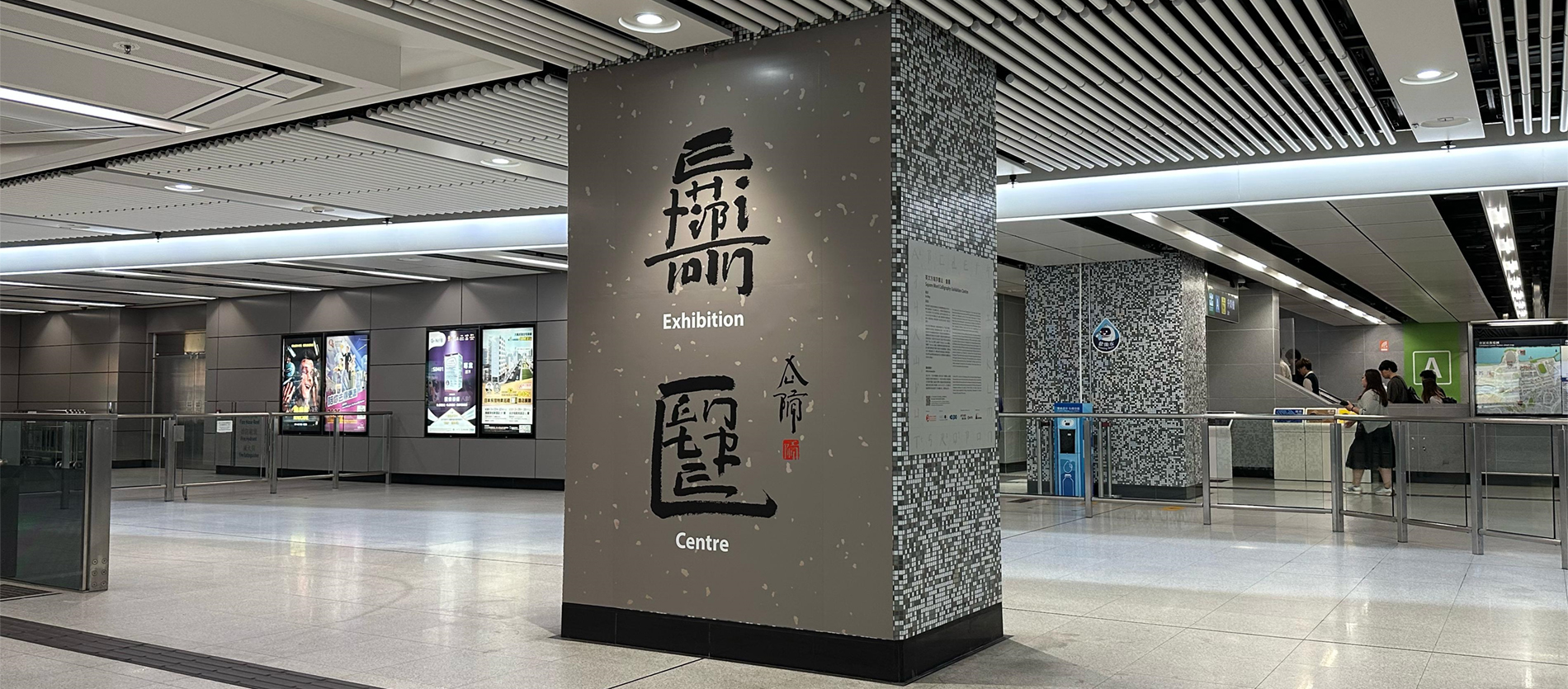
Xu’s work at Exhibition Centre MTR station (Photo: Art Promotion Office)
At Sheung Wan Station, a greeting — “long time no see” — rendered in Square Word Calligraphy opens a dialogue with passersby.
At Admiralty, Exhibition Centre and Wan Chai stations, the station names in Square Word Calligraphy reflect different translation principles used for place names in Hong Kong. “Wan Chai” is a phonetic translation, “Exhibition Centre” is a semantic translation, and “Admiralty” is derived from the area’s historical background. These three typical examples of translation approaches showcase the linguistic diversity of Hong Kong.
What ultimately captivates Xu is not just form, but transformation. “This work interests me because it challenges the limits of human thinking — it carries a kind of liberation, a liberation of the mind,” he says. As Square Word Calligraphy moves from gallery walls to subway stations, it not only brings art into everyday life but also invites the public to reflect on how language shapes identity. In Hong Kong, Xu’s hybrid art finds a particularly resonant home.
For more information, follow HKeye social media handles:
YouTube:https://www.youtube.com/@HKeye2023.
Facebook:https://www.facebook.com/HKeye.hk/.
TikTok:https://www.tiktok.com/@hkeye_.
Cover Photo: Art Promotion Office
責編 | 李永康
編輯 | Claire
編輯推薦
-
![]()
Game On GBA | All-in-One Sports Experience in Macao
HK Eye | 2025-10-27 07:55 -
![]()
Greater Bay Area Conference 2025: Uniting Finance, Talent, and Culture for GBA Growth
HK Eye | 2025-10-23 17:27 -
![]()
Game On GBA | Life as a circuit: Racing culture in Macao
HK Eye | 2025-10-17 15:37 -
![]()
Game On GBA | Nature at Hong Kong's doorstep at Fanling
HK Eye | 2025-10-13 15:05 -
![]()
HKUST-SINO One Million Dollar Entrepreneurship Competition 2025 Empowers New Generation to Build a Tech-Driven Future
HK Eye | 2025-10-03 14:18 -
![]()
Game On GBA | Hong Kong’s Sporting Heart at Kai Tak
HK Eye | 2025-10-02 16:10

美國布朗大學槍擊案|多人中槍至少2死8重傷 警方指正追捕1名男槍手
宏福苑五級火|議員促檢討招標機制 協助業主物色承建商避免圍標

俄烏戰爭|烏國敖德薩能源設施遭俄軍空襲 引發全國7個地區大停電

泰柬衝突|安華再次介入調停要求停火 泰國:將會繼續作戰

乒乓香港總決賽|南韓組合直落3:0奪混雙冠軍 「莎頭組合」獲亞軍

美國宣布解除白俄鉀肥制裁 盧卡申科指赦免123名囚犯
旺角虛擬貨幣店主遇持刀行劫沒損失 賊人乘的士逃去